Modeling, Control, and Simulation for Embodied Unmanned Systems: Intelligent Unmanned Systems Control Practice
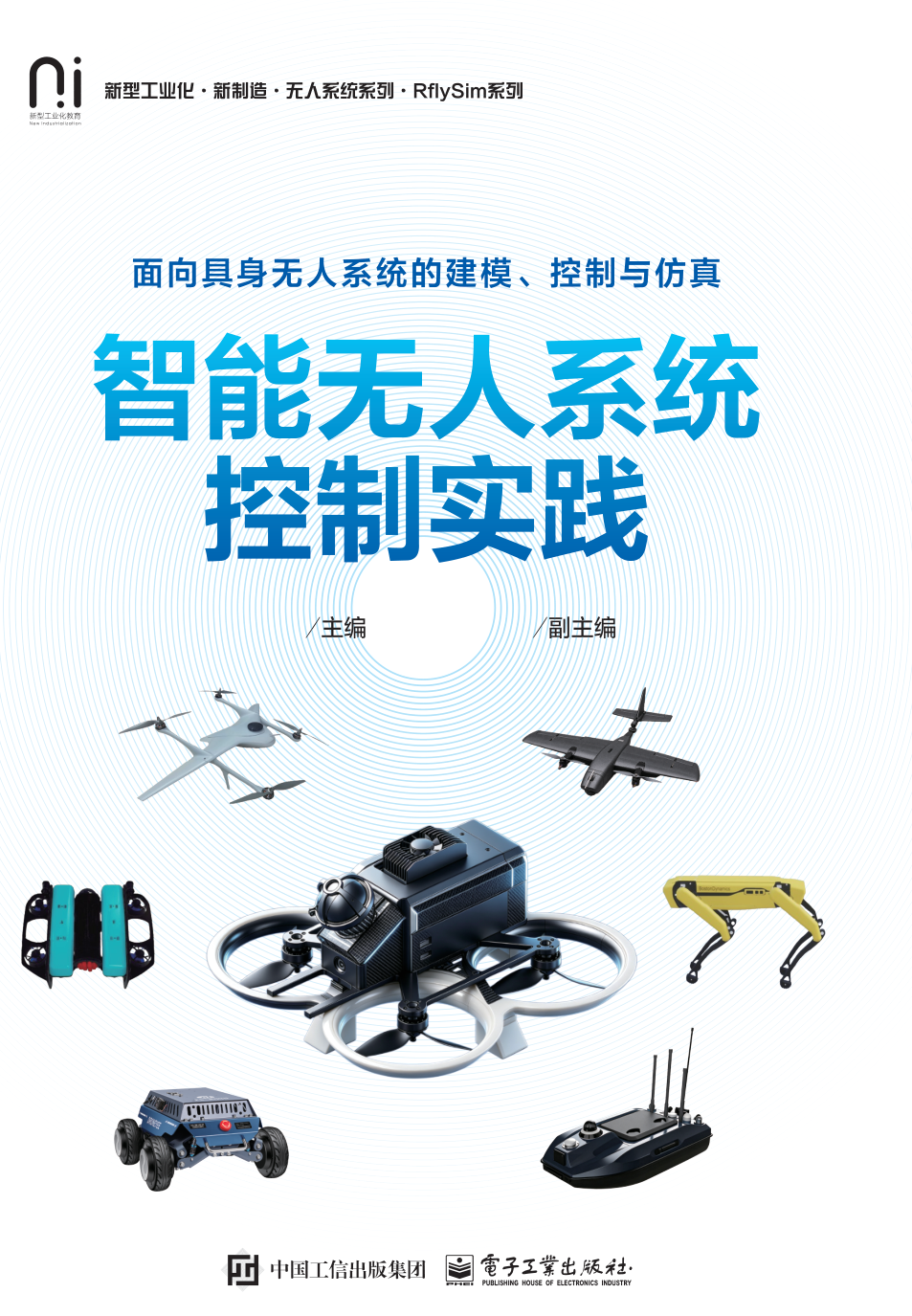
The development of intelligent unmanned systems involves multiple aspects, including modeling, control, perception, communication, and decision-making. It requires both systematic theoretical knowledge and reproducible engineering practice. Centered on model-based design (MBD), this book proceeds across three levels—conceptual learning, tool utilization, and experimental validation. It introduces key technologies such as swarm collaboration, task allocation, path planning, networked communication, perception fusion, fault diagnosis, and game-theoretic decision-making; reviews the application methods of commonly used development tools, including MATLAB/Simulink, ROS, PX4/MAVLink, Unreal Engine, and Python/C++; and leverages the RflySim toolchain to integrate system modeling, algorithm design, simulation validation, and deployment. The book establishes a progressive experimental pathway from algorithm validation, software-in-the-loop simulation, and hardware-in-the-loop semi-physical simulation to real-vehicle testing. It also addresses dynamic model accuracy, three-dimensional environment reconstruction, and sim-to-real transfer, helping readers gradually master the development and validation methods for embodied unmanned system control algorithms. The purchase link for this book is available at: 「JD.com」, or scan the QR code below to access the purchase page.
Click to expand the QR code image

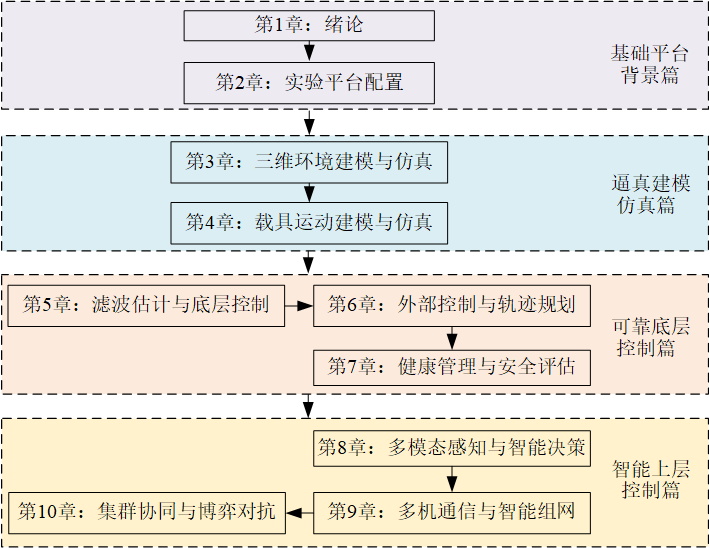
The book is organized into four stages: “fundamental platforms and background,” “high-fidelity modeling and simulation,” “reliable low-level control,” and “intelligent high-level control.” Chapters 1–2 introduce system concepts and experimental platforms; Chapters 3–4 develop three-dimensional environments and vehicle motion models; Chapters 5–7 discuss filtering and estimation, control development, and safety assessment; and Chapters 8–10 extend to perception and decision-making, multi-vehicle communication, and swarm collaboration. The figure below illustrates the progressive relationship among the ten chapters.
Courseware Directory (PDF)
Download all courseware PDFs (ZIP, approximately 148 MB)
The compressed archive contains 85 courseware files for Chapters 1–10, with chapter folders retained.
Chapter 1 Introduction and System Architecture
Beginning with the concepts, classification, and system architecture of intelligent unmanned systems, this chapter introduces commonly used coordinate systems, control principles, multirotor assembly and debugging, and the RflySim toolchain. Read the detailed introduction for this chapter.
Download courseware (8 PDFs)
| Contents | Courseware | Contents | Courseware | Contents | Courseware |
|---|---|---|---|---|---|
| 1.1 Concept Classification and Applications | ppt | 1.2 Development History and Trends | ppt | 1.3 Components and Architecture | ppt |
| 1.4 Coordinate Systems and Control Principles | ppt | 1.5 Assembly and Debugging | ppt | 1.6 RflySim Toolchain | ppt |
| 1.7 Learning Path and Experimental Cases | ppt | 1.8 Exercises and Classroom Discussion | ppt |
Chapter 2 Experimental Platform Configuration
This chapter introduces configuration methods for the RflySim toolchain and key software, completes installation verification and the first simulation, and explains the platform architecture and basic development workflow. Read the detailed introduction for this chapter.
Download courseware (6 PDFs)
| Contents | Courseware | Contents | Courseware | Contents | Courseware |
|---|---|---|---|---|---|
| 2.1 Introduction to Key Tools | ppt | 2.2 Platform Installation and First Simulation | ppt | 2.3 Platform Architecture and Development Workflow | ppt |
| 2.4 API and SDK Development Interfaces | ppt | 2.5 Example Framework and Experimental Path | ppt | 2.6 Exercises and Classroom Discussion | ppt |
Chapter 3 Three-Dimensional Environment Modeling and Simulation
Focusing on Unreal Engine scenes and vehicle models, this chapter introduces three-dimensional simulation, rendering and interaction, multimodal sensor data generation, and distributed simulation interfaces. Read the detailed introduction for this chapter.
Download courseware (7 PDFs)
| Contents | Courseware | Contents | Courseware | Contents | Courseware |
|---|---|---|---|---|---|
| 3.1 Fundamentals of Three-Dimensional Simulation and Tool Selection | ppt | 3.2 UE Scene Execution, Rendering, and Interaction | ppt | 3.3 Multimodal Sensor Data Generation | ppt |
| 3.4 Distributed Simulation Architecture and Data Interfaces | ppt | 3.5 Scene and Vehicle Asset Development | ppt | 3.6 Example Framework and Integrated Practice | ppt |
| 3.7 Exercise Case Analysis and Course Design | ppt |
Chapter 4 Vehicle Motion Modeling and Simulation
Starting from kinematics and dynamics, this chapter explains vehicle model construction, parameter measurement, and system identification, and extends to code generation and model deployment. Read the detailed introduction for this chapter.
Download Courseware (12 PDF files)
| Contents | Courseware | Contents | Courseware | Contents | Courseware |
|---|---|---|---|---|---|
| 4.1 Fundamentals of Motion Modeling and Kinematics | ppt | 4.2 Rigid-Body Dynamics and Motion Solution | ppt | 4.3 Modeling of Power Units, Forces, and Observations | ppt |
| 4.4 Trim, Linearization, and Fundamentals of Dynamic Systems | ppt | 4.5 Step-by-Step Programming and Simulation of Multirotor Models | ppt | 4.6 Parameter Measurement and Static Model Identification | ppt |
| 4.7 Dynamic System Identification, Validation, and Model Refinement | ppt | 4.8 Modeling and Extension of Typical Unmanned Vehicles | ppt | 4.9 Modeling Tools, Code Generation, and Model Deployment | ppt |
| 4.10 API and SDK Modeling Interfaces | ppt | 4.11 Example Framework and Integrated Practice | ppt | 4.12 Exercise Case Analysis and Course Design | ppt |
Chapter 5 Filtering, Estimation, and Low-Level Control
Introduces sensor calibration, filtering and estimation, controller design and control allocation, as well as PX4 low-level control development, performance evaluation, and experimental tuning. Read the detailed introduction to this chapter.
Download Courseware (8 PDF files)
| Contents | Courseware | Contents | Courseware | Contents | Courseware |
|---|---|---|---|---|---|
| 5.1 Fundamentals of Filtering, Estimation, and Low-Level Control | ppt | 5.2 Sensor Calibration and Filtering Estimation | ppt | 5.3 Controller Design and Control Allocation | ppt |
| 5.4 Control Performance Evaluation and Tuning | ppt | 5.5 PX4 Architecture and Control Development Interfaces | ppt | 5.6 Low-Level Control Development and Experimental Validation | ppt |
| 5.7 Other Vehicle Types and Advanced Control Cases | ppt | 5.8 Exercises and Classroom Discussion | ppt |
Chapter 6 External Control and Trajectory Planning
Explains external control modes and communication interfaces, integrating trajectory generation, obstacle avoidance, and trajectory tracking to complete algorithm development and simulation validation. Read the detailed introduction to this chapter.
Download Courseware (9 PDF files)
| Contents | Courseware | Contents | Courseware | Contents | Courseware |
|---|---|---|---|---|---|
| 6.1 Fundamentals of External Control and Control Hierarchy | ppt | 6.2 Principles and Modes of External Control | ppt | 6.3 Trajectory Planning Modeling and Generation | ppt |
| 6.4 Trajectory Planning Algorithms and Obstacle Avoidance | ppt | 6.5 Principles of Trajectory Tracking and High-Maneuverability Control | ppt | 6.6 Frontier Technologies and Control Methods | ppt |
| 6.7 Platform Framework and Communication Interfaces | ppt | 6.8 External Control Examples and Experimental Validation | ppt | 6.9 Exercises and Classroom Discussion | ppt |
Chapter 7 Health Management and Safety Assessment
Centers on fault modeling and injection, health prediction, safety assessment, and safety decision-making, and introduces experimental validation methods that integrate simulation and physical systems. Read the detailed introduction to this chapter.
Download Courseware (9 PDF files)
| Contents | Courseware | Contents | Courseware | Contents | Courseware |
|---|---|---|---|---|---|
| 7.1 Fundamentals of Health Management and Safety Assessment | ppt | 7.2 Unified Fault Modeling Framework | ppt | 7.3 Simulation-to-Physical Safety Enhancement and Fault Data Methods | ppt |
| 7.4 Fault Hazards and Safety Assessment | ppt | 7.5 Fault Diagnosis and Health Prediction | ppt | 7.6 Safety Decision-Making and Overall Vehicle Improvement | ppt |
| 7.7 Fault Injection Interfaces and Algorithm Development Framework | ppt | 7.8 Example Experiments and Simulation-to-Physical Validation | ppt | 7.9 Exercises and Classroom Discussion | ppt |
Chapter 8 Multimodal Perception and Intelligent Decision-Making
Introduces image processing, target recognition and tracking, multimodal perception fusion, localization and mapping, and obstacle avoidance decision-making, with attention to real-world deployment. Read the detailed introduction to this chapter.
Download Courseware (9 PDFs)
| Contents | Courseware | Contents | Courseware | Contents | Courseware |
|---|---|---|---|---|---|
| 8.1 Background, Significance, and Fundamentals of Image Processing | ppt | 8.2 Object Recognition, Tracking, and Optical Flow Estimation | ppt | 8.3 Localization, Mapping, and Predictive Planning | ppt |
| 8.4 Common Perception Sensors | ppt | 8.5 Multimodal Perception Coordinate Transformation | ppt | 8.6 Multimodal Fusion and Control Decision-Making | ppt |
| 8.7 Key Tools and Framework Interfaces | ppt | 8.8 Experimental Cases and Sim-to-Real Transfer | ppt | 8.9 Exercises and Classroom Discussion | ppt |
Chapter 9 Multi-Vehicle Communication and Intelligent Networking
Starting with multi-vehicle communication mechanisms and protocols, this chapter introduces wireless channel and interference modeling, RflySim networking simulation, and related development interfaces. Read the detailed introduction to this chapter.
Download Courseware (8 PDFs)
| Contents | Courseware | Contents | Courseware | Contents | Courseware |
|---|---|---|---|---|---|
| 9.1 Networking Communication Fundamentals and Background Requirements | ppt | 9.2 Hardware Selection Criteria and Communication Mechanisms | ppt | 9.3 Software Layering and Communication Protocols | ppt |
| 9.4 Communication Modeling and Interference Simulation | ppt | 9.5 RflySim Networking Framework and Communication Simulation | ppt | 9.6 Key Communication Protocols and Development Interfaces | ppt |
| 9.7 Experimental Cases and Comprehensive Validation for This Chapter | ppt | 9.8 Exercises and Classroom Discussion | ppt |
Chapter 10 Swarm Collaboration and Game-Theoretic Competition
This chapter introduces swarm collaboration, formation consensus, intelligent game theory, and multi-agent reinforcement learning, and validates swarm algorithms using RflySim. Read the detailed introduction to this chapter.
Download Courseware (9 PDFs)
| Contents | Courseware | Contents | Courseware | Contents | Courseware |
|---|---|---|---|---|---|
| 10.1 Fundamentals of Swarm Collaboration and Control Architecture | ppt | 10.2 Consensus and Formation Control | ppt | 10.3 Fundamentals of Intelligent Game Theory and Reinforcement Learning | ppt |
| 10.4 Classical Single-Agent Reinforcement Learning Algorithms | ppt | 10.5 Multi-Agent Reinforcement Learning and Scalability | ppt | 10.6 Key Swarm Technologies and Challenges | ppt |
| 10.7 RflySim Swarm Framework and Interfaces | ppt | 10.8 Experimental Cases and Comprehensive Validation for This Chapter | ppt | 10.9 Exercises and Classroom Discussion | ppt |