Practice of Flight Control for Micro-Sized Fixed-Wing UAVs
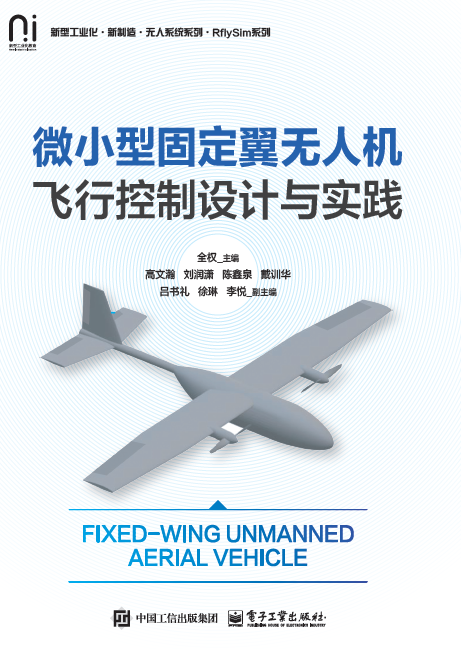
Micro-sized fixed-wing UAVs are finding increasingly broad applications in both military and civilian domains. In military contexts, they can undertake tasks that traditional aircraft struggle to accomplish, such as reconnaissance, surveillance, rescue, and special operations. The widespread adoption of UAVs drives the urgent need to cultivate more full-stack engineers specializing in UAV flight control development. A full-stack UAV engineer refers to a professional equipped with multidisciplinary competencies, including UAV hardware and software design, control system development, data processing, and application implementation. To train more such full-stack UAV flight control engineers more effectively, we have authored this book. Its objective is to enable readers with no prior background to quickly get started, master advanced development methodologies, and keep pace with cutting-edge technologies. This book emphasizes fundamentality, completeness, systematicity, and a certain degree of technological advancement. It includes eight UAV experiments covering design, modeling, control, planning, and vision algorithms. The experiments progress gradually from fundamentals to hardware-in-the-loop simulation, providing guidance on using software tools such as MATLAB/Simulink and Python, as well as hardware platforms like CubePilot, aiming to cultivate practical capabilities.
Companion code for this textbook can be downloaded directly via e10-FixedWingCtrl.zip. Since the code in this book is developed based on the RflySim toolchain, users must first download the RflySim toolchain, install it, and then navigate to the corresponding chapter folders as indicated in the table below. Before conducting experiments, please carefully read the
Readme.pdffile in each folder. Due to ongoing updates and iterations of RflySim, the specific experimental procedures may differ slightly from those described in the textbook; therefore, theReadme.pdffile should be considered authoritative.
| Chapter | Slides | Code |
|---|---|---|
| Chapter 1 – Introduction | ppt | None |
| Chapter 2 – Experimental Platform Configuration and Development Workflow | ppt | code |
| Chapter 3 – Level Flight Performance Evaluation Experiment | ppt | code |
| Chapter 4 – Modeling of Controlled Dynamic Systems Experiment | ppt | code |
| Chapter 5 – System Identification Experiment | ppt | code |
| Chapter 6 – Low-Level Flight Control Experiment | ppt | code |
| Chapter 7 – Path Following and Planning Experiment | ppt | code |
| Chapter 8 – Trajectory Planning and Differential Flatness Control Experiment | ppt | code |
| Chapter 9 – Image-Based Servoing and Docking Control Experiment | ppt | code |
| Chapter 10 – Swarm Flight Control Experiment | ppt | code |